Screen, puff, HD, DTF — which one your artwork actually needs
Five printing techniques, and an honest account of what each is good at, what it costs you, and when it is the wrong choice. Most brands arrive having already picked the wrong one.
· 4 min read · Minimalistic Garments · Printing
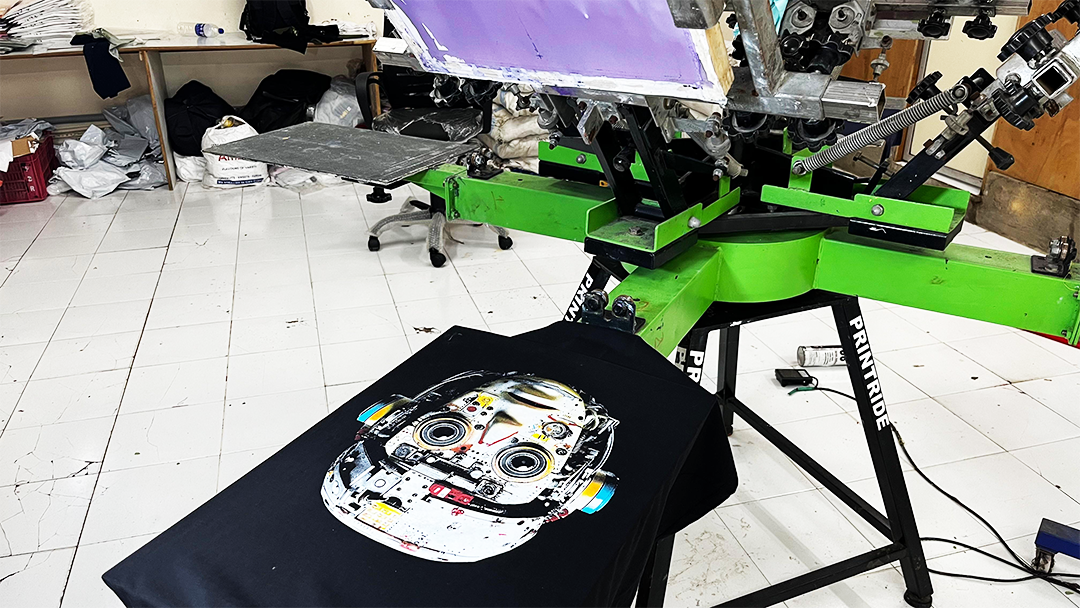
Almost every brand that comes to us has already decided they want screen printing.
That is not because they have compared the options. It is because screen printing is the one people have heard of. It is the technique with a name that sounds like proper manufacturing, and it carries an assumption of quality that the other methods somehow do not.
Sometimes it is right. Often it is not, and Raj — who has been printing garments for twenty years — is the person who says so. Here is what he is weighing.
Screen printing
Ink is pushed through a mesh screen onto the fabric, one screen per colour.
What it is good at. Bold, flat, confident artwork at volume. The colour sits dense and opaque on the garment, it survives washing extremely well, and it is consistent across hundreds of pieces in a way nothing else quite matches.
What it costs you. Every colour in your design needs its own screen, and every screen has to be made. That cost is the same whether you print thirty pieces or three thousand, which is the entire economics of the technique in one sentence. At volume it is the cheapest thing on this list. At thirty pieces with a four-colour design, the setup can cost more than the garments.
When it is wrong. Fine detail, photographic images, gradients, or anything with a lot of colours on a short run. A design with soft edges will come out looking harder and coarser than your file.
Screen printing also has variants worth knowing:
- HD — a finer mesh and tighter registration, for sharper detail than standard screen. Still limited by the one-screen-per-colour maths.
- Puff — an additive that expands under heat, raising the print off the fabric. Genuinely tactile, and very good on simple bold shapes. It softens detail, so it is the wrong home for fine line work.
- Neon and UV — pigments that hold their intensity under artificial light. Useful when garments will be seen at events rather than in daylight.
DTF
Direct-to-film prints your artwork onto a film, which is then heat-pressed onto the garment.
What it is good at. Full colour, without a screen per colour. Photographs, gradients, complex illustration, artwork with forty shades in it — DTF does not care, because there is no separation step. It also holds intricate detail cleanly, and it works across a wide range of fabrics, from cotton through to polyester blends.
What it costs you. No setup cost to speak of, which is precisely why it is usually the right answer at thirty pieces. The per-piece price does not fall away at volume the way screen printing does, so somewhere in the hundreds the economics cross over.
When it is wrong. Very large runs of simple artwork, where screen printing will be cheaper and give a slightly more traditional finish. Also worth knowing: a large solid DTF area sits on top of the fabric and is less breathable than a screen print of the same size.
If you are launching a first drop with colourful artwork, this is almost always the technique you want, and almost never the one you asked for.
Sublimation
Heat turns the ink into a gas, which bonds into the fibre itself rather than sitting on the surface.
What it is good at. All-over prints — patterns that run across seams, edge to edge, with no border and no panel where the print stops. Because the ink is in the fabric rather than on it, the print cannot crack, peel or fade the way a surface print eventually will, and the garment stays as soft and breathable as an unprinted one.
What it costs you. The fabric requirement, which is absolute rather than a preference. Sublimation needs polyester, and it needs the garment to be white or light-coloured, because the ink is translucent and cannot lay a light colour over a dark one. There is no workaround.
When it is wrong. Cotton. A black base. A single small chest logo, where you would be paying for a whole-garment process to print something the size of a postcard.
The actual decision
Skip the technique names and answer four questions about your own design.
How many colours, and how sharp are the edges? Two flat colours with clean edges points at screen. Photographic, gradient-heavy or many-coloured points at DTF.
How many pieces? Under a hundred, DTF is usually cheaper once setup is counted. Several hundred and up, screen pulls ahead and keeps going.
Does the print need to cover the whole garment? Then it is sublimation, and your fabric and colour are decided for you.
What is the garment made of? Cotton rules sublimation out entirely. Polyester blends are fine for DTF. This is worth settling before you fall in love with a technique.
What we will actually do
Send us the artwork and the quantity, and we will tell you which of these it should go on, including when that is the cheaper one.
That last part is not generosity. Recommending the expensive option every time is a good way to win one order and lose the brand — and the brands we produce in the thousands for today are, almost without exception, the ones who started with thirty pieces and got told the truth about them.